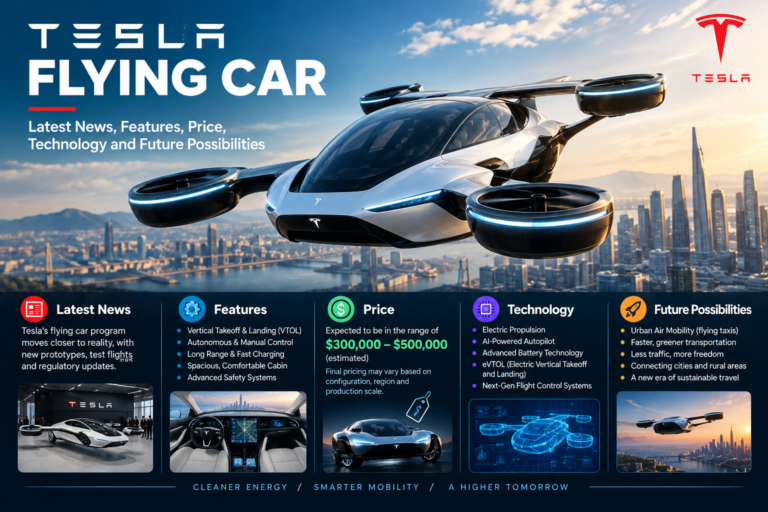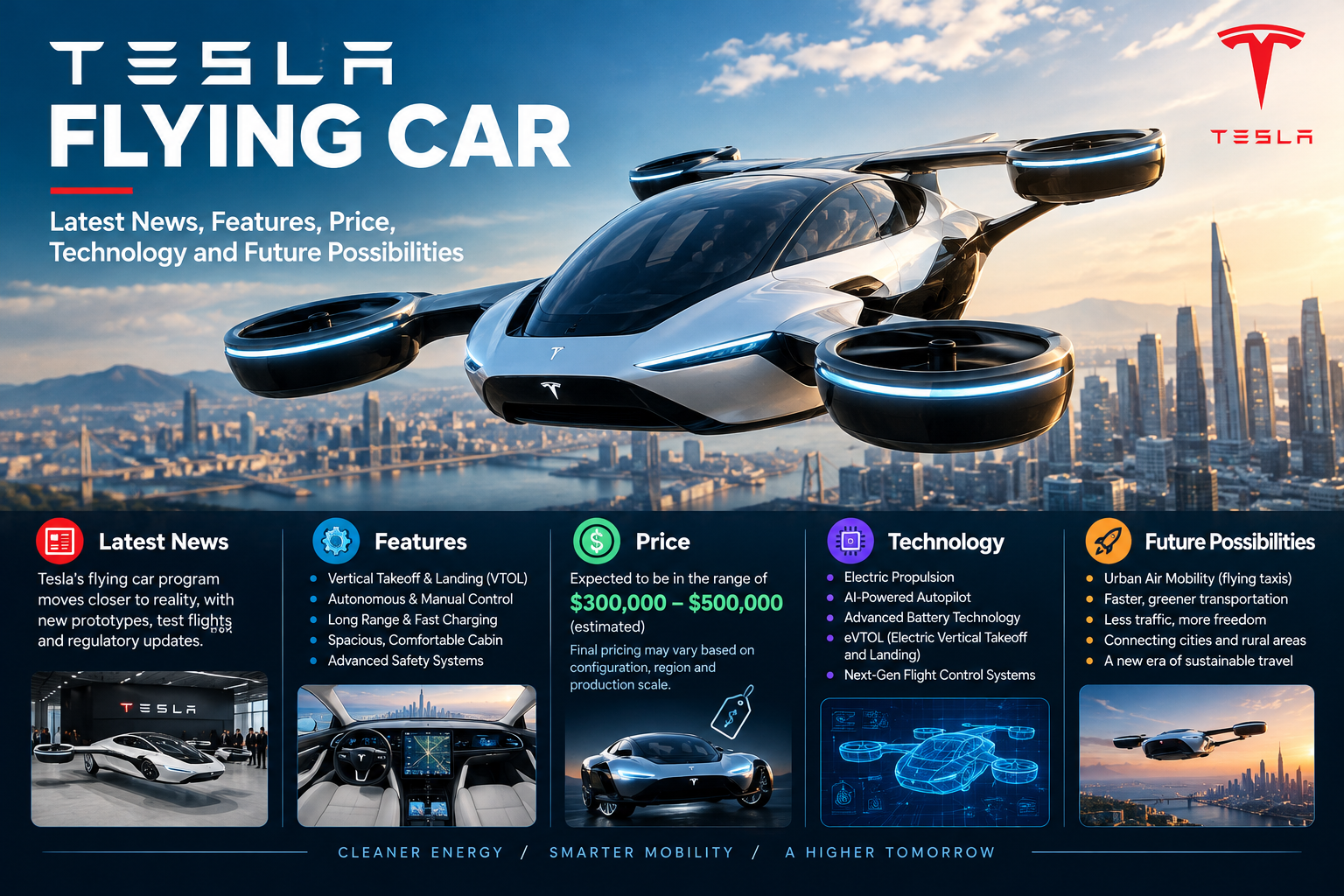
Introduction: Is the Tesla Flying Car Finally Becoming a Reality?
Imagine driving your electric car on a highway and then watching it lift into the air, perform an incredible aerial move, and land back on its wheels. This sounds like something from a science-fiction movie, but Tesla has recently brought this idea closer to reality with a demonstration of its next-generation Roadster.
The Tesla flying car has become a major talking point among car enthusiasts, technology fans and people interested in the future of transportation. Tesla CEO Elon Musk has spoken about combining electric vehicle technology with advanced aerospace engineering for years. In October 2026, a Roadster demonstration featuring rocket-style thrusters attracted worldwide attention.
However, there is an important difference between a vehicle performing a brief airborne stunt and a practical flying car that people can use for everyday travel.
The new Roadster demonstration showed unusual capabilities, but its commercial availability, flight performance and regulatory approval remain important questions. The vehicle is not yet an ordinary flying car available for public use. Source: Reuters
Let’s explore what is known about the Tesla flying car concept, its possible features, expected price, technology and future potential.
What Is the Tesla Flying Car?
The term Tesla flying car is commonly used to describe Elon Musk’s vision of a vehicle that combines the performance of an electric sports car with technology capable of producing limited flight or airborne movement.
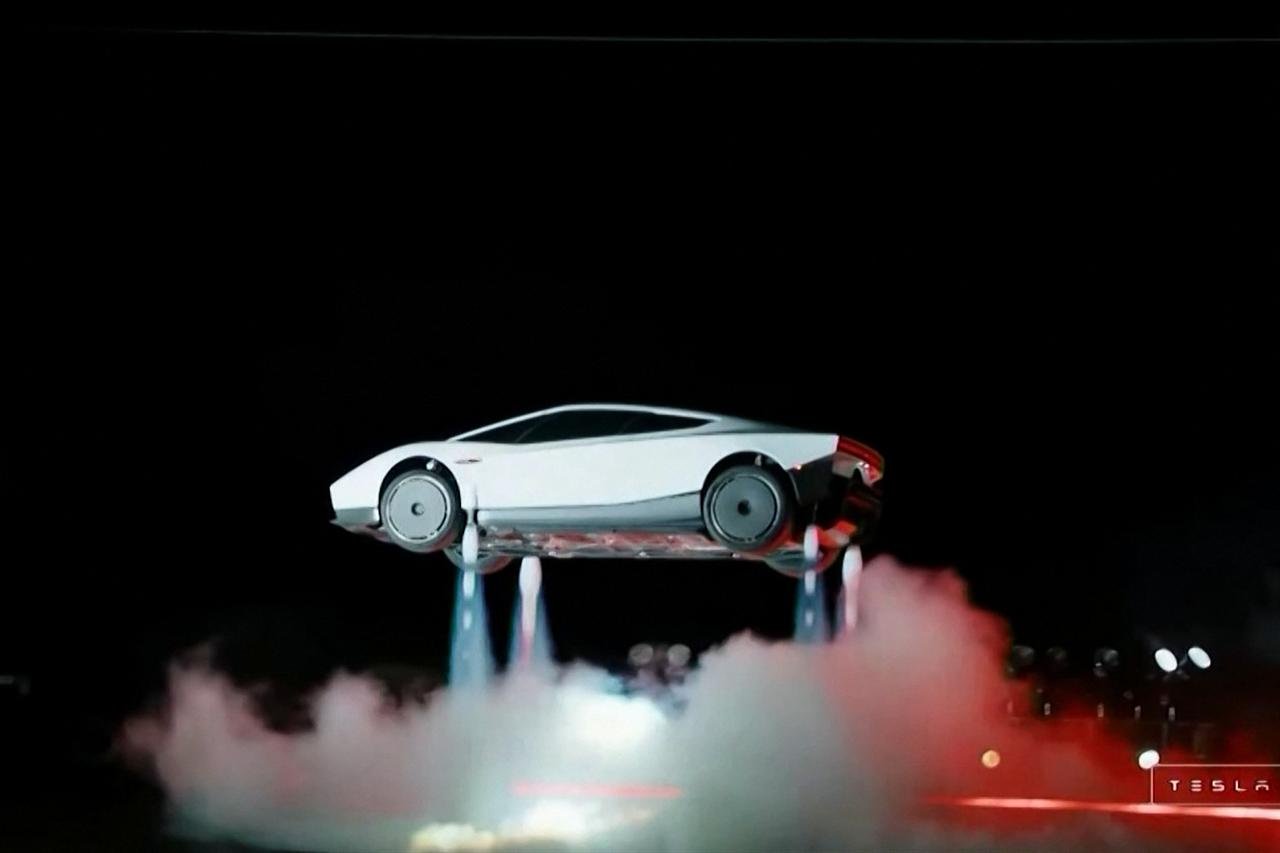
Tesla’s latest Roadster demonstration featured a car using high-pressure gas thrusters to perform an airborne manoeuvre. The technology was presented in connection with SpaceX, Musk’s aerospace company.
Unlike conventional electric cars, which rely on tyres and road surfaces for movement, a rocket-assisted vehicle can use directed thrust to generate force in a different direction. This creates possibilities for unusual movement, although it does not automatically make the vehicle suitable for sustained flight.
A traditional flying car would normally need a reliable way to generate lift, maintain stability, control its direction and land safely. Depending on its design, it might use wings, rotors, electric propulsion systems or other aviation technology.
The Tesla Roadster is primarily an electric sports car concept with experimental aerospace-inspired capabilities. It should not be confused with a certified aircraft or an electric air taxi.
Latest Tesla Flying Car News in 2026
Tesla’s next-generation Roadster has attracted renewed interest following its October 15, 2026, demonstration in Texas.
The event showcased a futuristic vehicle performing dramatic movements, including a brief airborne manoeuvre and a mid-air rotation. The demonstration also highlighted the potential use of rocket-style thrusters and a suction-based system for unusual vehicle movement.
The Roadster has been discussed for years, with its original next-generation announcement dating back to 2017. Production plans have experienced repeated delays, and the latest reports point towards 2028 as the intended production start.
This is an important distinction for anyone searching online for a Tesla flying car: a public demonstration does not mean that the final production model is ready for delivery.
The demonstrated vehicle’s capabilities also do not establish that customers will be able to fly over traffic, travel long distances through the air or use the car as an everyday aircraft.
For accurate updates, buyers should check Tesla’s official Roadster website and read the latest product information before making purchasing decisions.
Tesla Flying Car Features: What Could Make It Different?
The final specifications of any production vehicle must be confirmed by Tesla. Nevertheless, several technologies associated with the Roadster concept help explain why it has generated so much interest.
1. Rocket-Style Thrusters
One of the most unusual features shown in the demonstration was the use of high-pressure gas thrusters.
These systems direct pressurised gas through nozzles to create thrust. In principle, carefully controlled thrust can move a vehicle or help produce a short airborne manoeuvre.
However, the technology presents substantial challenges. A practical vehicle would need enough thrust, reliable control systems and a safe method of managing the forces involved.
A short demonstration is not proof that the vehicle can hover for extended periods or fly like a helicopter.
2. High-Performance Electric Powertrain
Tesla is known for developing electric vehicles with rapid acceleration and responsive power delivery.
The next-generation Roadster has been presented as a high-performance electric sports car. Its electric drivetrain is separate from the rocket-style propulsion technology demonstrated at the event.
Combining high acceleration with an experimental thrust system could create an extraordinary driving experience. Still, the actual performance of a customer-ready version will depend on its final engineering and production specifications.
3. Advanced Aerodynamic Design
Aerodynamics play a major role in high-performance vehicles. The shape of a car affects air resistance, stability, energy consumption and high-speed handling.
A potential flying vehicle would face even more complicated aerodynamic requirements. Engineers would need to consider how air flows around the body during take-off, airborne movement and landing.
The final design would also need to balance passenger protection, weight, cooling requirements and structural strength.
4. Experimental Vehicle Control
A vehicle capable of unusual airborne movements would require precise control of its direction, balance and propulsion.
Advanced sensors and electronic control systems could potentially help manage these functions. However, the specific production systems and safety features of the Roadster’s experimental thruster technology have not been fully established publicly.
It would be premature to assume that a production Tesla flying car will offer fully autonomous flight.
5. Futuristic Interior and Driver Experience
Tesla’s Roadster has been promoted as a high-performance sports car with a futuristic design.
A future version could combine a minimalist cabin, digital vehicle controls and advanced driver assistance technology. Any aircraft-like functionality would also require suitable occupant restraints, emergency procedures and safety provisions.
The final interior and passenger capacity should be confirmed from official production specifications rather than concept images or social media videos.
Tesla Flying Car Price: How Much Could It Cost?
One of the most common questions is how much a Tesla flying car will cost.
There is no confirmed, final retail price for a production-ready flying Tesla with fully approved flight capabilities. The Roadster’s reservation arrangements and experimental Rocket version should not be treated as proof of a completed consumer product.
Its eventual cost could depend on the production configuration, propulsion technology, materials, engineering requirements and regulatory approvals.
For customers in India, the total ownership cost would also depend on import duties, applicable taxes, shipping and any necessary compliance requirements.
It is important to separate the following three things:
- Tesla Roadster: A high-performance electric sports car under development.
- Rocket-assisted Roadster concept: An experimental configuration demonstrating unusual thrust-based movement.
- Practical flying car: A vehicle certified and equipped for safe, repeatable flight under applicable aviation regulations.
These are not interchangeable products.
Anyone considering a reservation should review the current official terms, refund conditions, delivery statements and exact vehicle configuration before committing money.
How Could a Tesla Flying Car Work?
The basic principle behind a rocket-assisted airborne vehicle is Newton’s third law of motion: when gas is expelled in one direction, the resulting reaction force pushes the vehicle in the opposite direction.
In a simplified example, if a propulsion system directs gas downwards, it produces an upward force on the vehicle.
For sustained flight, the upward force must be sufficient to support the vehicle’s weight. The system must also manage pitch, roll, yaw and changes in direction.
This creates several engineering challenges.
First, the vehicle needs enough stored energy or propellant to generate the required thrust. Second, its control system must respond quickly to disturbances. Third, the vehicle must maintain stability during take-off and landing.
A conventional electric car is designed around road contact, braking and tyre grip. A flying vehicle must deal with additional forces and risks that do not occur in ordinary driving.
This is why an airborne stunt, even an impressive one, is only one part of the broader challenge of creating a practical flying car.
Tesla Flying Car vs Traditional Electric Cars
Tesla’s experimental Roadster concept and its conventional electric cars serve different purposes.
An ordinary electric vehicle is designed to provide reliable road transportation, predictable handling and convenient charging. A flying-capable vehicle would require additional propulsion equipment, more complex control systems and potentially extensive aviation certification.
Traditional electric cars are also easier to integrate into existing roads, parking spaces and charging infrastructure.
A flying vehicle could offer new travel possibilities, but it would introduce questions about take-off locations, flight routes, weather conditions, noise, emergency landings and airspace management.
For most drivers, a conventional electric car remains the more practical choice for everyday journeys. A flying vehicle would need to demonstrate clear benefits before becoming a mainstream alternative.
Potential Benefits of Flying Cars in the Future
If flying cars eventually become safe, affordable and widely approved, they could change how people think about personal transportation.
Reduced Travel Time on Selected Routes
Airborne transportation could potentially reduce journey times between certain locations, particularly where geography makes road travel difficult.
However, take-off procedures, airspace restrictions and landing requirements would affect the total journey time.
New Transportation Options
Future flying vehicles could create additional transport choices for remote communities, specialised travel and certain emergency-response operations.
Whether a personal flying car is suitable for any particular use would depend on its design, range and regulatory approval.
Progress in Engineering
Research into advanced propulsion, lightweight materials, sensors and vehicle control can contribute to broader engineering innovation.
Some technologies developed for specialised vehicles may eventually influence other transport applications.
These potential benefits are promising, but they should not be mistaken for benefits already available from the Tesla Roadster.
Major Challenges Tesla Must Overcome
Developing a vehicle that can move through the air safely is much harder than designing a high-performance road car.
Safety: A propulsion failure, loss of stability or emergency landing could have serious consequences. Systems would need rigorous testing and dependable failure-management procedures.
Regulation: Road vehicles and aircraft are subject to different rules. Authorities would need to determine which standards apply to a vehicle with both road and flight capabilities.
Energy and propulsion: A flying vehicle must generate enough lift or thrust to support its weight. The energy and equipment required can limit range and increase complexity.
Noise: Rocket-style propulsion can create substantial noise. A practical personal flying vehicle would need to consider the impact on nearby residents and other aircraft.
Cost: Advanced materials, specialised components, maintenance and certification could make a flying-capable vehicle expensive.
Infrastructure: Drivers cannot simply take off wherever they want. Approved operating locations, safe landing areas and suitable airspace arrangements may be necessary.
Overcoming these challenges will be essential before a flying Tesla could become a routine form of transportation.
When Will the Tesla Flying Car Be Available?
As of October 2026, the next-generation Roadster has been demonstrated publicly, but its production and delivery remain uncertain.
Tesla has indicated a target production start in 2028. That target should not be interpreted as a guaranteed delivery date, and it does not confirm when a fully approved flying-capable version might become available.
A production vehicle would need to match its advertised specifications and satisfy the relevant requirements for its intended use.
Potential buyers should watch for verified announcements about manufacturing, customer deliveries, final specifications and legal operating conditions.
The timeline for a conventional Roadster and the timeline for a practical flying car may be very different.
Is the Tesla Flying Car Worth Waiting For?
For technology enthusiasts, the Roadster’s experimental capabilities are certainly interesting. The demonstration shows how automotive engineering and aerospace concepts might come together in new ways.
However, buyers who need a reliable vehicle today should focus on available cars rather than making decisions based on future flight promises.
Before placing a reservation, consider your budget, the vehicle’s confirmed features, delivery uncertainty and the difference between experimental demonstrations and certified capabilities.
For now, the Tesla flying car is best viewed as an ambitious engineering development rather than a ready-to-use replacement for conventional transportation.
Frequently Asked Questions
1. Is the Tesla flying car real?
Tesla demonstrated a next-generation Roadster with rocket-style thrusters performing a brief airborne manoeuvre in October 2026. However, this does not establish that a fully operational, certified flying car is available for everyday use.
2. What is the Tesla flying car price?
A final retail price for a production-ready flying-capable Tesla has not been confirmed. The cost will depend on the final model, configuration and approved capabilities.
3. When will the Tesla flying car launch?
Tesla has indicated a 2028 production target for the next-generation Roadster. Actual production and delivery dates remain uncertain, and this does not guarantee the availability of a certified flying version.
4. Can the Tesla Roadster fly over traffic?
There is no established evidence that the demonstrated Roadster can safely and legally fly over public roads or traffic as an everyday aircraft. Its brief airborne demonstration should not be confused with sustained flight capability.
5. Will the Tesla flying car be available in India?
There is no confirmed Indian launch date for a production-ready flying-capable Tesla. Availability would depend on the final product, import arrangements and applicable vehicle and aviation regulations.
6. Does the Tesla flying car use SpaceX technology?
The demonstrated Roadster featured rocket-style thrusters associated with SpaceX aerospace engineering. The exact production configuration and availability of these systems must be confirmed.
7. Is the Tesla flying car fully autonomous?
Fully autonomous flight has not been established as a confirmed production capability. Advanced vehicle automation and autonomous aircraft operation are different technical and regulatory challenges.
8. Is Tesla developing a flying car or an electric sports car?
The Roadster is primarily presented as a high-performance electric sports car, with an experimental configuration demonstrating unusual airborne movement. A practical, certified flying car is a separate and more demanding goal.
Conclusion
The Tesla flying car concept represents an exciting intersection of electric vehicles, aerospace engineering and futuristic transportation. The October 2026 Roadster demonstration has made the idea more tangible, but important questions about production, safety, price and flight certification remain unanswered.
For now, the best approach is to follow official Tesla announcements and reliable automotive reporting rather than relying on viral videos or unverified specifications.
The future of flying vehicles could be fascinating, but turning a dramatic demonstration into a safe, affordable and legally usable transportation option will require much more than a successful stunt.